Irrigation system installation
Even coverage, no dry patches, no wasted water.

Get a free quote
By submitting you agree to be contacted about your project. We respect your privacy. For faster service, call (801) 949-1533.
What's included
A properly zoned irrigation system waters turf, planting beds, and trees differently, because they don't need the same amount of water. We design each zone around what's actually planted there instead of running one blanket schedule for the whole yard.
That includes sprinkler heads for lawn areas, drip lines for beds and foundation planting, and a controller you can actually operate without a manual, including smart controllers that adjust for weather.
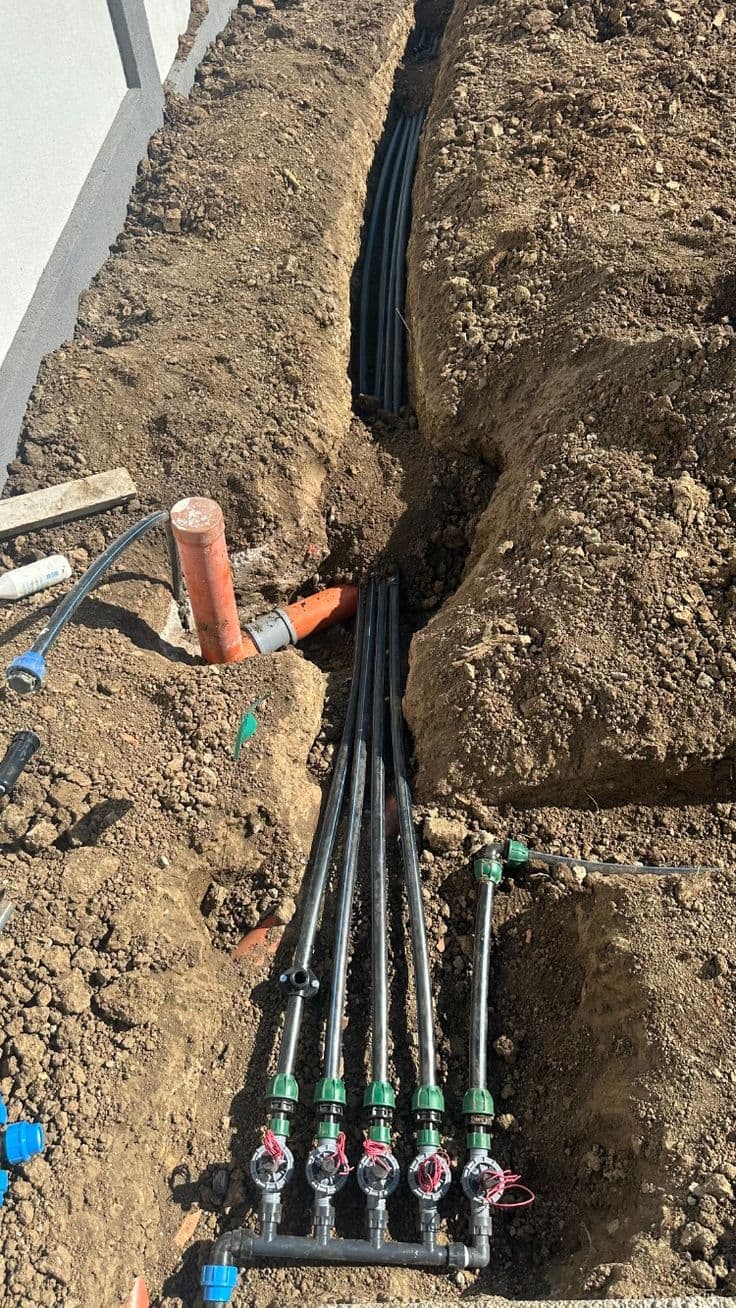
The install itself starts with trenching — mainline runs about 12" deep, lateral lines closer to 8", both below the reach of a typical aerator or shovel. We run Schedule 40 PVC for the mainline and pressure-rated poly or PVC for laterals, group heads into zones by water need (turf rotors on one zone, shrub/bed sprays on another, drip on a separate low-flow zone) so nothing gets over- or under-watered, and every system gets a backflow preventer (a pressure vacuum breaker or double-check assembly, per Utah plumbing code) installed above grade to keep irrigation water from siphoning back into your home's drinking water.
Head selection matters as much as the pipe: rotors throw further and suit large, regular turf areas; spray heads cover smaller or oddly shaped zones; drip emitters go under mulch in planting beds where spray would waste water on bare soil. Every system also needs a proper fall blowout — compressed air pushed through the lines at 50–80 psi to clear water before a hard freeze — since a valve or backflow device that freezes solid with water still in it is the single most common (and most avoidable) irrigation failure we see in the Salt Lake Valley.
How it works
Step by step, here's what actually happens on site:
- 1Measure static water pressure (PSI) and flow rate (GPM) on site to determine how many zones the system needs
- 2Trench mainline 12–18" deep and lateral lines 6–12" deep, per standard industry depth guidelines
- 3Install a backflow preventer (pressure vacuum breaker or double-check assembly) above grade, required by Utah plumbing code
- 4Lay Schedule 40 PVC mainline and PVC or poly lateral lines, solvent-welded or compression-fit at every joint
- 5Install a valve manifold grouped by zone and run low-voltage wire back to the controller
- 6Set zones by plant type — turf rotors, shrub/bed sprays, and drip irrigation each on their own zone
- 7Pressure-test the system and check for even coverage before backfilling any trenches
- 8Program the controller (including smart/Wi-Fi models) and walk you through it before we leave
Why Ironwood
We size and zone systems around Salt Lake Valley water pressure and the state's seasonal watering guidance, so you're not overwatering during restricted months or under-watering new sod while it establishes.
Irrigation is installed as part of the same grading and hardscape plan — lines get placed before patios and walkways go in, not squeezed in around them afterward.
We zone by plant type, not just by area of the yard, so a shady drip zone for foundation planting never runs on the same schedule as a full-sun turf zone that needs three times the water.
Our process
- 01
Consultation
We walk your property, listen to how you want to use the space, and talk through rough budget and timeline — no pressure, no obligation.
- 02
Design
We put together a plan with real material choices and layout, sized to your yard and your budget, not a generic template.
- 03
Build
Our crew handles grading, base prep, and installation to spec, with the owner checking in on progress at key milestones.
- 04
Walkthrough
We walk the finished space with you, confirm everything meets expectations, and cover care and maintenance before we consider the job done.
Project gallery
Irrigation system installation FAQ
Can you add irrigation to an existing landscape, not just new construction?
Yes — retrofitting an existing yard is common. We'll work around established plantings and hardscape as much as possible.
Do you install smart/Wi-Fi controllers?
Yes, and we'll set it up and walk you through it so it's actually usable, not just installed.
What about winterization?
Utah winters require a proper blowout with compressed air to prevent freeze damage to lines, valves, and the backflow device — we can advise or handle this as part of ongoing service every fall.
How deep do you bury the lines, and will they survive an aerator?
Mainline sits around 12 inches deep and laterals around 8 — both below where a core aerator or hand shovel would reach in normal use.