Concrete patio installation
Clean, durable, low-maintenance patio surfaces.

Get a free quote
By submitting you agree to be contacted about your project. We respect your privacy. For faster service, call (801) 949-1533.
What's included
A poured concrete patio gives you a clean, seamless surface with lower long-term maintenance than pavers — good for a modern look, a budget-conscious project, or a large continuous area like a pool deck.
We offer broom-finish for a simple, slip-resistant surface, stamped concrete for a textured pattern that mimics stone or pavers at a lower cost, and exposed aggregate for a durable, decorative finish.
The build sequence: excavate and compact the subgrade, set forms to the exact grade and a slope of about a quarter-inch per foot away from the house, then place wire mesh or rebar on chairs so it sits centered in the slab instead of resting on the dirt (reinforcement that touches the ground doesn't do its job). We pour a minimum 4-inch slab, finish it broom, stamped, or exposed-aggregate depending on your choice, and cut control joints within about 24 hours at intervals roughly 2 to 3 times the slab thickness in feet — that's what tells the concrete where to crack invisibly as it cures and shrinks, instead of cracking wherever it wants.
How it works
Step by step, here's what actually happens on site:
- 1Excavate and compact the subgrade to a uniform density
- 2Set forms to the exact grade, sloped about a quarter-inch per foot away from the house
- 3Place wire mesh or rebar on chairs so it sits centered in the slab, not resting on the dirt
- 4Pour a minimum 4" slab
- 5Finish it broom, stamped, or exposed-aggregate depending on your choice
- 6Cut control joints within about 24 hours, spaced roughly 2–3 times the slab thickness in feet
- 7Cure moist for at least 7 days; full strength is reached at 28 days
Why Ironwood
We reinforce and control-joint every pour correctly for Utah's frost depth, which is what actually prevents the random cracking that gives concrete patios a bad reputation.
Grading and drainage are planned before the pour, not after, so water moves away from your house instead of pooling on the patio.
Control joints get cut within a day of the pour on every job — skip or delay that step and the slab picks its own crack line instead of the one you planned for.
Our process
- 01
Consultation
We walk your property, listen to how you want to use the space, and talk through rough budget and timeline — no pressure, no obligation.
- 02
Design
We put together a plan with real material choices and layout, sized to your yard and your budget, not a generic template.
- 03
Build
Our crew handles grading, base prep, and installation to spec, with the owner checking in on progress at key milestones.
- 04
Walkthrough
We walk the finished space with you, confirm everything meets expectations, and cover care and maintenance before we consider the job done.
Project gallery
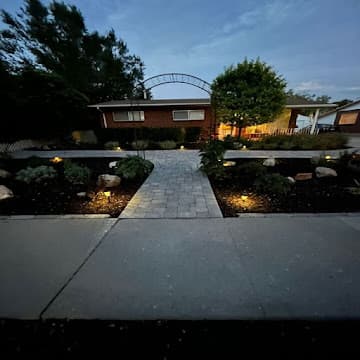
Concrete patio installation FAQ
Will my concrete patio crack?
All concrete can develop hairline cracks over time, but proper reinforcement, control joints, and base prep prevent the structural cracking that actually causes problems.
How long before I can use a new concrete patio?
Concrete typically needs about a week before light foot traffic and roughly 28 days to fully cure and reach full strength.
Stamped concrete vs. pavers — which is better?
It depends on your budget and preference. Stamped concrete is often more budget-friendly upfront; pavers are easier to repair individually if something ever needs fixing. We'll walk you through the tradeoffs for your project.